

The Cost of Disinformation: How Fake Reviews, Fraud and Deepfakes Drained $417 Billion
Disinformation cost the global economy an estimated $417 billion in 2024, according to a new study.
It is no longer just a political problem. 94% of that cost, or $393 billion, is financial, coming from fraud, market manipulation and commercial deception.
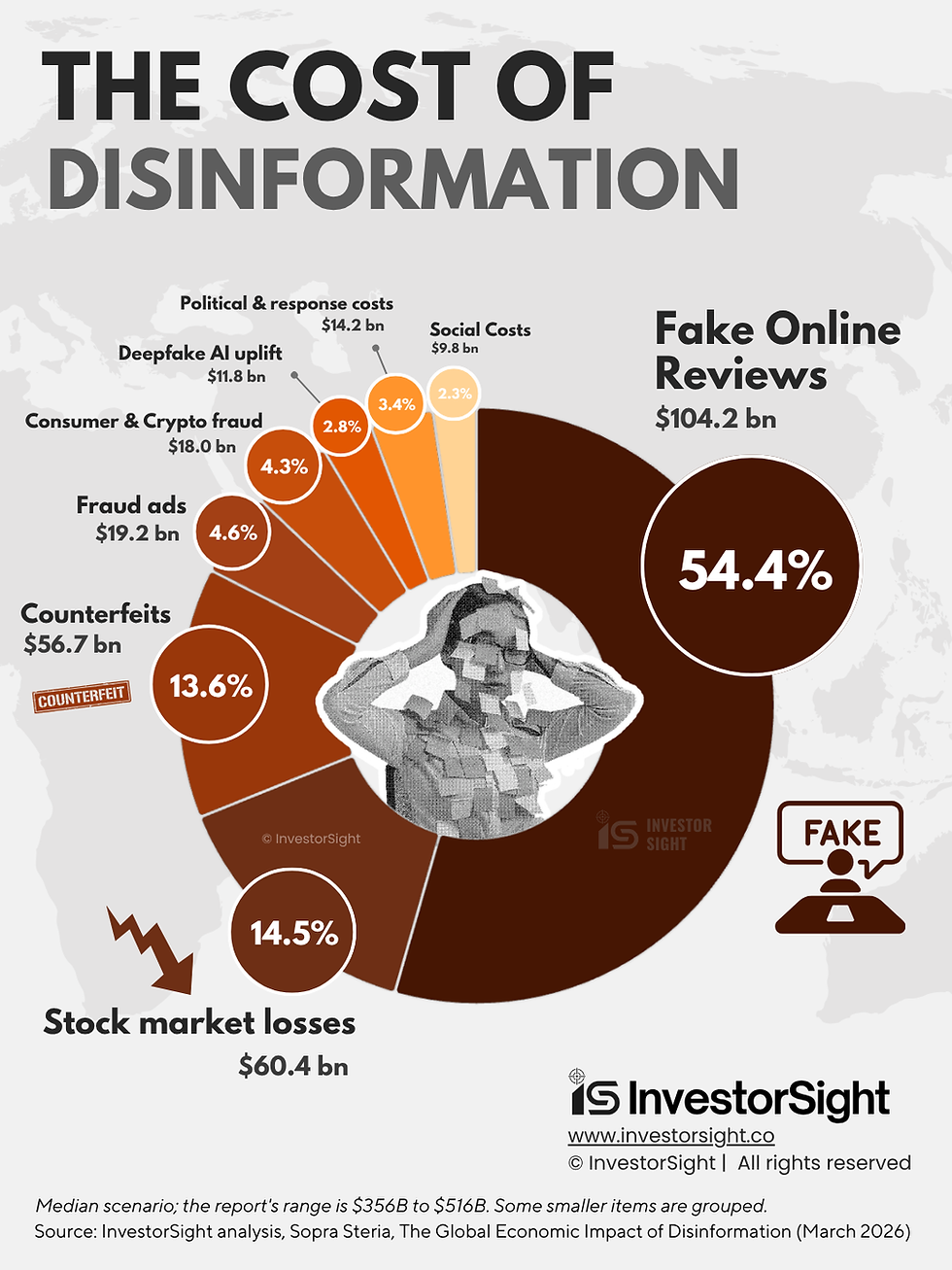
A new study by Sopra Steria puts the cost of disinformation at an estimated $417 billion in 2024. In fact, this is one of the first serious attempts to measure the economic impact of fake news, online fraud and information manipulation at a global scale.
How Much Does Disinformation Cost the Global Economy?
The study's median scenario is $417.1 billion, within a range of $356 billion to $516 billion. Financial costs make up $393 billion, or 94% of the total. Political and response costs add about $14 billion, and social costs such as polarisation add roughly $10 billion. The last comparable global estimate, from 2019, was $78 billion, though the two studies use different methods.
Fake Online Reviews Are the Biggest Driver
Fake reviews account for $227 billion, more than half of the total. This is not money stolen, but consumer spending influenced by fraudulent ratings. Online ratings influence an estimated 89% of global e-commerce revenue, so fake reviews push shoppers toward weaker products and penalise honest sellers.
Additionally, counterfeit goods sold on false claims add roughly $57 billion under the study's median assumptions.
Stock Market Manipulation and Online Fraud
Stock market losses tied to false information come to about $60 billion, based on 0.05% of global market value. Real cases show how fast it can happen. In 2013, a hacked Associated Press account posted a false White House explosion story and briefly wiped $136 billion off the S&P 500 in two minutes.
Fraud adds more, with US consumers reporting $12.5 billion in losses in 2024 and crypto scams such as pig butchering generating $5.5 billion.
How Deepfakes and AI Fraud Raise the Cost
Generative AI makes scams cheaper and more convincing. At this point, we've all probably seen the deepfake videos and AI generated content around us.
The study estimates that deepfakes add 15% to the cost of financial fraud and market manipulation in its median scenario, and 20% in its exploratory one. That share is likely to grow as AI tools spread faster than detection.
The Response Gap
Meta reportedly earned $16.45 billion from ads on fraudulent content in 2024, around 10% of its advertising revenue. By comparison, the study counted about $100 million for global fact checking initiatives. Total political and response costs came to $14 billion, mostly private sector spending on monitoring and detection.
Why $417 Billion Is Likely a Floor
The study only counts costs it can link to identified campaigns, and it focuses mainly on foreign influence operations. Domestic disinformation, mental health costs and effects on savings are largely left out, and the data leans toward the US and Western Europe. The authors describe their figure as a floor, not a ceiling.
What It Means for Investors and Businesses
For investors, disinformation is a risk factor that touches market volatility, brand reputation and consumer trust. E-commerce platforms, social media companies and financial institutions face the most direct pressure. Demand for fraud prevention, cybersecurity and content authentication is most definitely to grow as the cost becomes harder to ignore.
If you're interested in reading the entire report and analysis, you can find it here.


Comments