

Ranked: Countries with Largest Oil Reserves in the World
Who owns the world’s largest oil reserves?
Oil is one of the world’s most import resources and accounts for 70% of global energy demand in spite of the energy transition. This underscores its importance in trade flows, geopolitics and industrial activity.
In fact, just 4 countries control half of the world’s proven oil reserves and Venezuela solely owns almost 20%.
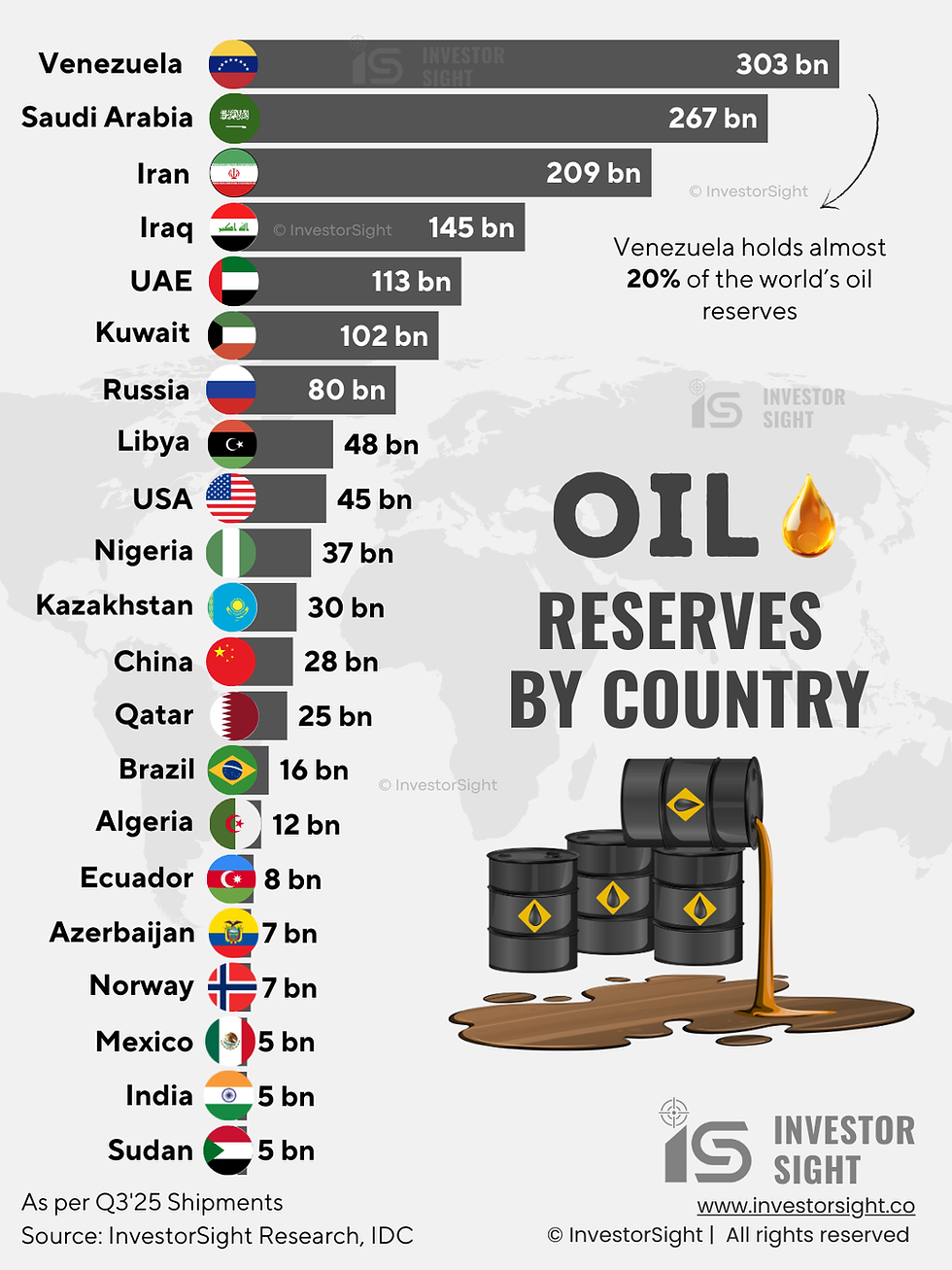
View this visual on Instagram
Interestingly, after capturing Venezuelan President Nicolás Maduro, U.S. President Donald Trump has stated that the USA would take control of Venezuela’s oil reserves to build the country’s weak oil industry.
Despite Venezuela’s massive oil reserves, the country has struggled economically to build this industry, primarily due to accessibility. Most of the country’s oil is offshore and is considered to be dense, increasing the cost of extraction significantly. On the other hand, Saudi Arabia’s oil reserves are close to the land, while makes it easily accessible and cost effective to extract.
Here are the detailed rankings (as per WPR)
Country | Oil Reserves (2024) BBL | |
1 | Venezuela | 303 bn |
2 | Saudi Arabia | 267 bn |
3 | Iran | 209 bn |
4 | Iraq | 145 bn |
5 | UAE | 113 bn |
6 | Kuwait | 102 bn |
7 | Russia | 80 bn |
8 | Libya | 48 bn |
9 | USA | 45 bn |
10 | Nigeria | 37 bn |
11 | Kazakhstan | 30 bn |
12 | China | 28 bn |
13 | Qatar | 25 bn |
14 | Brazil | 16 bn |
15 | Algeria | 12 bn |
16 | Ecuador | 8 bn |
17 | Azerbaijan | 7 bn |
18 | Norway | 7 bn |
19 | Mexico | 5 bn |
20 | India | 5 bn |
21 | Sudan | 5 bn |
Note: 97% of Canada’s oil reserves are in the form of oil sands, which are excluded in this dataset. These are carbon-intensive to extract and more expensive.


Comments